Keywords:
4-20mA, 0-10V, +/-10V, 0-5V,
+/-5V, multiranging adc, analog to digital, analog digital, converters,
programmable logic controllers, plc, overranging, fault Related Parts
Analog-Signal Data Acquisition in Industrial Automation Systems
Abstract: Industrial
control systems continue to employ standard analog signals for
transmitting data between the process and the control equipment.
Robust, 4-to-20mA current-loop signals that are easily transmitted over
several thousand feet, ±5 and ±10V signals are also very common in
industrial systems.
This application note showcases Maxim's integrated Data
Acquisition System (DAS) solutions. Maxim's DAS solutions save board
space, power, and design time, while requiring minimal external
components to convert standard industrial analog signals.
Despite the availability of the digital field bus in several versions, industrial control systems continue to employ standard analog
signals for transmitting data between the process and the control
equipment. Process transmitters in a chemical plant, for example,
convert low-level temperature and pressure signals into robust,
4-to-20mA current-loop signals that are easily transmitted over several
thousand feet.
Speed and position sensors for machine tools and
automatic handlers in factory-automation environments generate unipolar
and bipolar voltage
signals, which are typically 0V to 5V, 0V to 10V, ±5V, or ±10V. In
addition, signals from the popular PT100 temperature-sensing element
are often used directly, without conversion, to a standard range such
as 10V or 20mA. As an RTD (resistive thermal device) made of platinum
(Pt), the PT100 exhibits a resistance of 100Ω at 0°C. Its resistance versus temperature characteristic is linear, and it offers a reasonably high level of output signal (>100mV when driven with a 1mA current source).
The control function in a process environment is implemented by PLCs
(programmable logic controllers), PCSs (process control systems), or
(more recently) by IPCs (industrial personal computers). Because these
devices are digital systems operating with process-specific software,
all analog signals must be converted to digital numbers before a
computer can read them.
A/D
conversion in a control system is performed by boards or boxes called
"analog peripherals." They connect to the CPU via the system's
back-plane bus, or a field bus if mounted remotely (on a machine, for
example). In addition to digital circuits (for communication with the
CPU), these peripheral units include various precision-analog and
mixed-signal components. Requirements for a larger number of channels
per board or for smaller packages (to mount on a machine) lead to
shortages of space and power that constitute a major challenge in
designing analog peripherals. The following circuits suggest
signal-conditioning techniques and describe an approach for digitizing
up to eight channels with a single chip.
Data-Acquisition System (DAS)
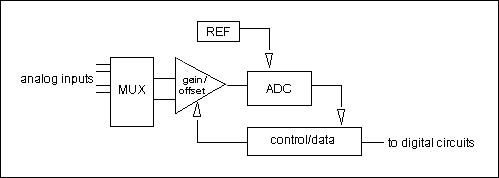
A state-of-the-art data-acquisition system (Figure 1) includes a multiplexer
(mux) for switching between input channels, a signal-conditioning
circuit that provides gain and offset adjustment for different input
ranges, and an analog-to-digital converter (ADC) with voltage reference
(VREF).
Figure 1. This diagram shows the basic components in a data-acquisition system.
By integrating the basic blocks of Figure 1, Maxim has produced a
family of one-chip data-acquisition systems that save board space,
power, and design time. Requiring few external components (none in some
cases), these chips convert most of the standard signals currently in
use. Each includes a 12-bit ADC, multiplexer, and gain/offset
correction, and features a serial or parallel digital interface that connects easily to most microprocessors.
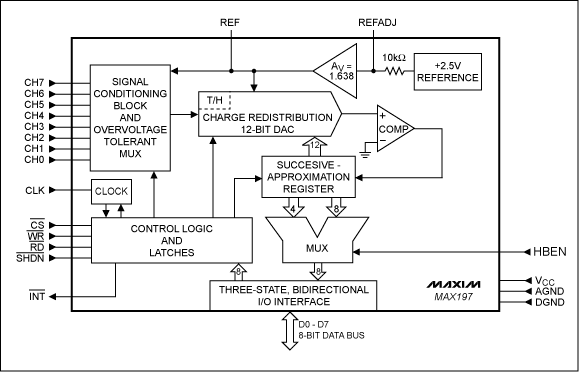
The following block diagram (Figure 2)
is typical for this family of chips. Differences are mainly in the
digital section, which connects to the microprocessor. Each chip has
six or eight single-ended analog-input channels that connect to the
internal ADC through a fault-protected multiplexer. Any channel can
withstand input voltages up to 16.5V, and a fault on any channel does
not affect conversions on any other channel.
Figure 2. The functions shown in Figure 1 are integrated in this chip.
Each channel can be programmed independently for one of the standard
input ranges (0 to 5V, 0 to 10V, ±5V, or ±10V) while operating from a
single 5V supply. Others have a similar gain structure but accept
different input ranges: unipolar or bipolar 2V or 4V, or unipolar or
bipolar VREF or _VREF. The ability to change the gain by a factor of
two and offset the input by 100% (from -10V to +10V) extends the dynamic range by 2 bits, producing a system with 14-bit dynamic range.
The internal ADC is a 12-bit successive-approximation type based on a capacitive DAC whose MSB
capacitor doubles as the hold capacitor in a track/hold circuit. Each
device can operate with the internal oscillator or with an external
clock.
By using active-low WR pulses to start and stop an
acquisition, MAX196-through-MAX199 devices in the "external acquisition
mode" can offer a relatively long acquisition time without slowing the
conversion. The device's short aperture delay and low aperture jitter
(<50ps in the external clock/acquisition mode) enable precise
control of acquisition time. This feature is important for
phase-sensitive applications such as power-line control and AC-motor
control. In addition, the chip's wideband
input structure provides small-signal bandwidths to 5MHz, which allows
undersampling techniques in which input frequencies exceed the Nyquist frequency.
Digital Interface
Applications that require high-speed measurements are best served with
a parallel-data interface (MAX196 through MAX199). These parts achieve
throughputs of 100Ksps at 2MHz clock rates, which is sufficient for
most high-speed control loops. For low-speed applications, the
available I²C-compatible-interface versions save board space and
simplify communications between the DAS and the microcontroller. These
parts have fast conversion times (10µs), but the serial interface limits their throughput to 8kbps.
The MAX197, for example, accepts 0V-to-10V, 0V-to-5V, ±5V, and ±10V inputs. Source impedance driving these inputs is the user's main concern. When sampling, the ADC draws current pulses to charge its T/H capacitor (the MSB capacitor of the capacitive DAC). Therefore, a fast-settling op amp with sufficient slew rate is required to ensure sufficient voltage settling during the acquisition time. MXL1013/MXL1014 op amps perform well for fast sampling rates. For slower op amps, the acquisition time must be extended.
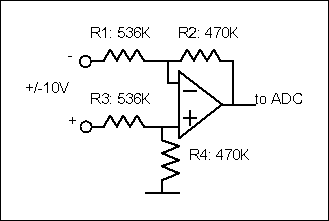
The differential inputs used in many automated systems are relatively insensitive to common-mode interference. Sufficient in most cases is a simple differential amplifier circuit (Figure 3)
whose input resistance exceeds 1MΩ. (For much higher input impedance,
use a standard 3-op-amp instrumentation amplifier.) The output shown in
Figure 3 is
VOUT = R2(V+ - V-)/R1.
For high common-mode rejection, make R1 = R3 and R2 = R4.
The combination shown has a gain of 0.876, which enables the
measurement of out-of-range signals by extending the ±10V input range
approximately 114%. This adjustment reduces resolution in the ±10V band
to approximately 11.8 bits.
Figure 3. A simple differential amplifier provides high input impedance and a single-ended output.
20mA Current Loops
Current loops transmit small signals over large distances in noisy environments. The current is usually generated by a process transmitter
that converts a variable such as temperature or pressure to a DC
current in the range 0mA to 20mA or 4mA to 20mA. Then, passing the
current through a shunt resistor produces a proportional voltage drop
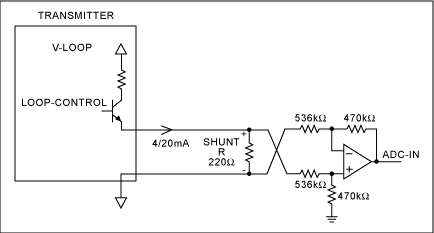
that is easily digitized. Because the compliance voltage available for
driving the loop (including wire resistance) is seldom more than 15V to
18V, the resistor value is limited to a few hundred ohms (Figure 4).
Figure
4. Combining the amplifier shown in Figure 3 with a current-loop signal
derived from a 220Ω shunt resistor produces a convenient single-ended
output.
This circuit has the same differential amplifier as
the ±10V conditioning circuit, together with a 220Ω shunt resistor,
which drops 4.4V at 20mA or 5.5V at 25mA. The gain of the differential
amplifier adjusts to a maximum of 4.62V at the ADC input, so a DAS
programmed for 0.5V inputs can digitize this signal with a maximum
resolution of 11.8 bits.
Because the MAX198/MAX199 and MAX128 have the smallest input ranges
available in this family, and therefore operate with a small shunt
resistor and require no gain adjustment, they are better suited for
20mA measurements in systems that require no other high-level
measurements (to ±10V). To adapt the circuit shown in Figure 4 for
operation with the MAX199, configure the MAX199 for its 0-to-2V input
range and change the 536kΩ resistors to 470kΩ. Use an 86Ω shunt
resistor.
Sensor Adaptation
Thermocouples, strain gauges, and other popular sensors deliver low-level nonlinear signals that are sensitive to EMI.
Before sending this information to a control system, therefore, a
4-to-20mA transmitter first linearizes and conditions the signal. For
temperature-measurement applications that are less critical, a
resistive thermal device (RTD) can measure temperatures as high as
850°C over a great distance and without expensive signal conditioning.
The most popular RTD is a standardized platinum temperature sensor called the PT100, which exhibits 100Ω resistance at 0°C and a linear
temperature coefficient of 0.38Ω/°C. It also has a nonlinear
temperature coefficient that is much smaller, so the Ω/°C
characteristic appears almost linear over a narrow range. Unlike
thermocouples, which deliver voltages that represent the difference
between two temperatures, the resistance of an RTD represents the
absolute temperature of that resistance.
Measurement is
accomplished by driving a current of 1mA to 2mA through the sensor and
measuring the voltage drop across it. Higher currents cause measurement
error due to self-heating caused by higher power dissipation within the
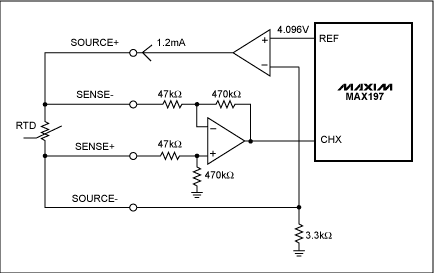
sensor. An internal 4.096V reference simplifies the generation of
excitation current for the sensor(Figure 5).
Figure 5. This circuit provides current to an RTD sensor and digitizes the resulting output.
To prevent wire resistance from affecting the measurement accuracy,
four separate wires connect the RTD to the differential amplifier.
Because the sense wires connect to the amplifier's high impedance
inputs, they have very low current and virtually no voltage drop. The
4096mV reference and 3.3kΩ feedback resistor sets the excitation
current to approximately 4096mV/3.3kΩ = 1.24mA. Thus, driving the ADC
and current source with the same reference voltage produces a
ratiometric measurement in which reference drift does not influence the
conversion result.
By configuring the MAX197 for an input range of 0V to 5V and setting
the differential amplifier for a gain of 10, you can measure resistance
values up to 400Ω, which represents about 800°C. The µP can use a
look-up table to linearize the sensor signal. To calibrate the system,
replace the RTD with two precision resistors (100Ω for zero and 300Ω or
higher for full span) and store the conversion results.
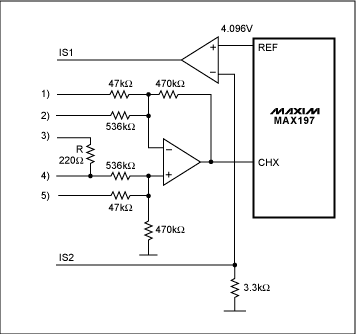
Rather than dedicating specific circuits for specific input ranges, use the following circuit (Figure 6)
to adapt the ADC input to any of the signal ranges described earlier.
Choosing an input pin and ADC input range (Table 1) selects the
appropriate configuration.
Figure 6. This universal-input circuit adapts the ADC to the signal range present on each input channel.
Table 1. Input Connections for Figure 6
INPUT CONNECT-->
1
2
3
4
5
ADC Range
±10V plus overrange
In-
In+
±10V
0mA- or 4mA-to-20mA, plus overrange
In-
In-
In+
0V to 5V
RTD
Sns-
Sns+
0V to 5V
For RTD: Sns- and Sns+ are sense connections on the four-wire configuration. Connect the "source" pins to IS1 and IS2.
A version of this article appeared in the February 9, 1999, issue of Control Engineering magazine.
Automatic Updates
Would you like to be automatically notified when new application notes are published in your areas of interest? Sign up for EE-Mail™.


 Download, PDF Format